
Why Invasive Species and Weather Extremes?
The Invasive Species and Weather Extremes (ISWE) Research to Management Dialogue brings together resource managers, agencies, Tribes, community members, and researchers working to address regional needs in combating invasive species under changing conditions. The goal of ISWE is to support dialogue that informs managers’ information needs and fills knowledge gaps related to invasive species and weather extremes. We aim to support actionable solutions by incorporating management expertise, state-of-the-science, and local and Indigenous knowledges of our community through webinars, working groups, practitioner-informed research, and informational resources.
Together with managers, the South Central CASC identified the need to facilitate connections and dialogue between researchers and managers to improve the resources needed to effectively manage invasive species in the context of weather extremes, while generating manager-relevant research that is responsive to managers’ needs and actionable for on-the-ground management.
The ISWE Dialogue is formatted as a short presentation followed by a discussion centered on challenges related to invasive species and weather extremes of interest to managers and researchers. A short summary paper containing resources related to the discussion, insights from attendees, and follow-up information will be available after the conclusion of each convening.
Survey
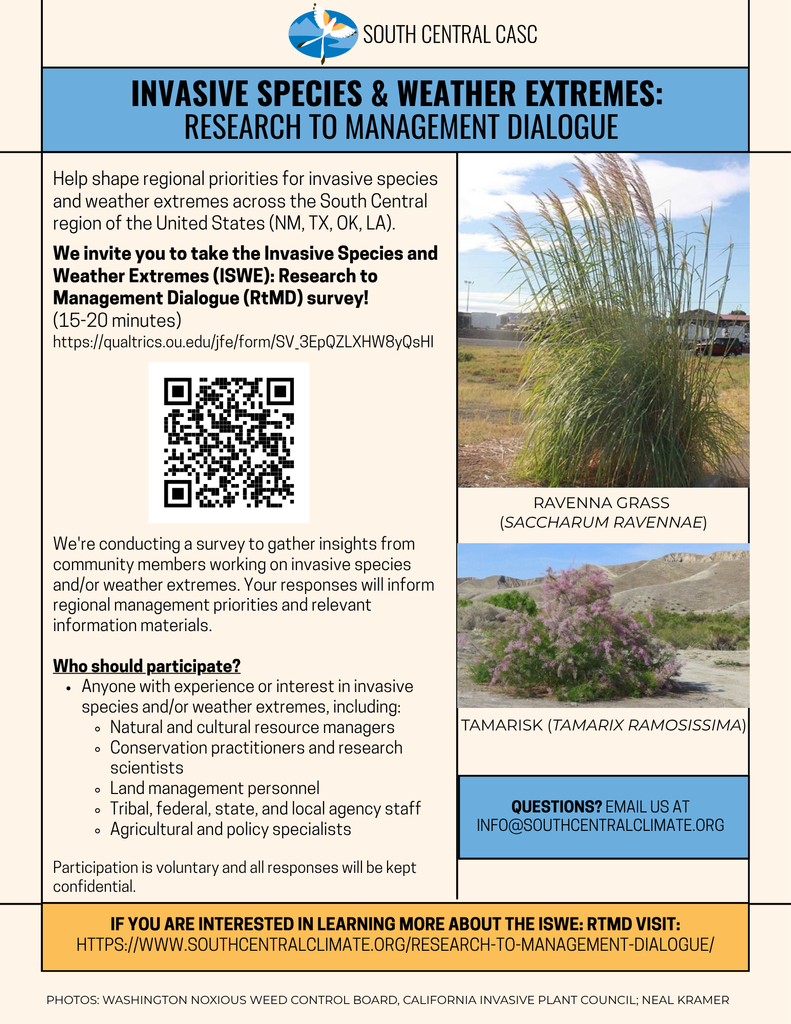
We invite you to take the Invasive Species and Weather Extremes (ISWE): Research to Management Dialogue (RtMD) survey! (15-20 minutes)
We’re conducting a survey to gather insights from community members working on invasive species and/or weather extremes. Your responses will inform the formation and priorities of the ISWE: Research to Management Dialogue across the South Central (NM, TX, OK, LA) region of the United States.
Who should participate?
- Anyone with experience or interest in invasive species and weather extremes, including:
- Natural and cultural resource managers
- Conservation practitioners and research scientists
- Land management personnel
- Tribal, federal, state, and local agency staff
- Agricultural and policy specialists
Participation is voluntary and all responses will be kept confidential. At the end of the survey, you can sign up for the South Central CASC and related listserv and opt in to participate in interviews and/or focus group discussions regarding priorities. You may also reach out to climateservices@southcentralclimate.org with questions.
Please share with your networks or any interested individuals!
Combined effects of changing conditions and invasive species:
The dual threats of weather extremes and invasive species are reducing ecosystem resilience and leading to accelerated biodiversity loss around the world. Across the United States, invasive species and weather extremes interact in a variety of ways that further complicate managing their spread. Within the South Central region (Oklahoma, Texas, New Mexico, and Louisiana), these impacts are seen across our range of ecoregions, with species and conditions shifting within and across borders. Changing ecological conditions can exacerbate existing impacts of invasive species, allow existing invasive species to expand their range into native habitats, and create new pathways for non-native species to invade new areas.
Objectives:
- Create and synthesize relevant, regional invasive species research and tools;
- Foster co-production and dialogue between managers and researchers; and
- Reduce the impact of invasive species across the region.
Defining Invasive Species
Invasive (Executive order 13112 definition): a species that is “non-native (or alien) to the ecosystem under consideration and whose introduction causes or is likely to cause economic or environmental harm or harm to human health.
Non-native: species who recently arrived in a new location that do not cause known negative consequences for people or ecological processes in the ecosystems in which they arrived (Golebie et al. 2022).
Discourse: There is a growing body of work addressing language surrounding invasive species, particularly in the context of rapidly changing ecological conditions. Addressing species using language such as native, alien, or invasive carries implications of good and bad and assigns positive and negative values (Warren 2021). Fusco et al. (2024) call for a framework to more effectively communicate about invasive species, rather than a standardized terminology, arguing “standardization could limit the linguistic flexibility needed to avoid terms with negative connotations for different interest groups.” Terms like ‘eradicate’, ‘natives’, and ‘colonizing’ can invoke the troubling and often violent context of these words for Indigenous groups.
Collaborators
iRISCC: Inter-Regional Invasive Species and Climate Change (RISCC) Network
The goal of the RISCC Network is to share the needs and knowledge of practitioners, build stronger scientist-practitioner relationships, and conduct priority research. There are currently 6 RISCCs, working together as part of the iRISCC network.The iRISCC Network includes the Northwest, North Central, Northeast, Southeast, Pacific Islands, and Canada. Louisiana is also a member state of the Southeast RISCC Network.
Informational Products
Coming soon
Invasive Species and Weather Extremes Research to Management Dialogue Topics
Coming soon