
The SC CASC is celebrating Earth Week by highlighting the current on-going projects that we are funding. Each day we’re highlighting research or topics related to Earth, Fire, Wildlife, Water, and People.
Monday: Earth
Assessing Future Changes to Spring Phenology and False Springs in the South Central United States – Adrienne Wootten (Funded Fiscal Year 2019)
False springs are when temperatures briefly warm up, causing the plants to bloom only to be followed by a hard freeze that can kill the young, sensitive buds. Studies show that the timing of first blooms has shifted to earlier in the year across the U.S., leading to significant damage to ecosystems, agriculture, and impacting reliant species.
Researchers will use projections of future climate conditions designed specifically for use in this region to improve our understanding of future changes in the timing of spring onset and the frequency and occurrence of false springs in the South Central U.S.
https://www.sciencebase.gov/catalog/item/5d1b7485e4b0941bde620d76
Understanding Impacts of Sea-Level Rise and Land Management on Critical Coastal Marsh Habitat – Camille Stagg (Funded Fiscal Year 2020)
Sea-level rise is causing the coastal marsh habitat to convert to open water resulting in the highest rates of wetland loss in the world, with nearly 1.2 million acres lost since the 1930s. This concern has led stakeholders to invest millions in extensive restoration efforts of these valuable habitats, including those for commercial fisheries. To maintain critical coastal wetlands in Louisiana, river diversions, a hydrologic management method, have been implemented for coastal restoration and have the potential for large-scale impact. Yet, there remains a critical need for a greater understanding of the short- and long-term effects of river diversions on coastal wetlands. It is necessary to understand the cause of wetland loss as well as accurately measure the effectiveness of restoration techniques to ensure the successful restoration of these vital habitats.
https://www.sciencebase.gov/catalog/item/5f315e4482ceae4cb3ca5195
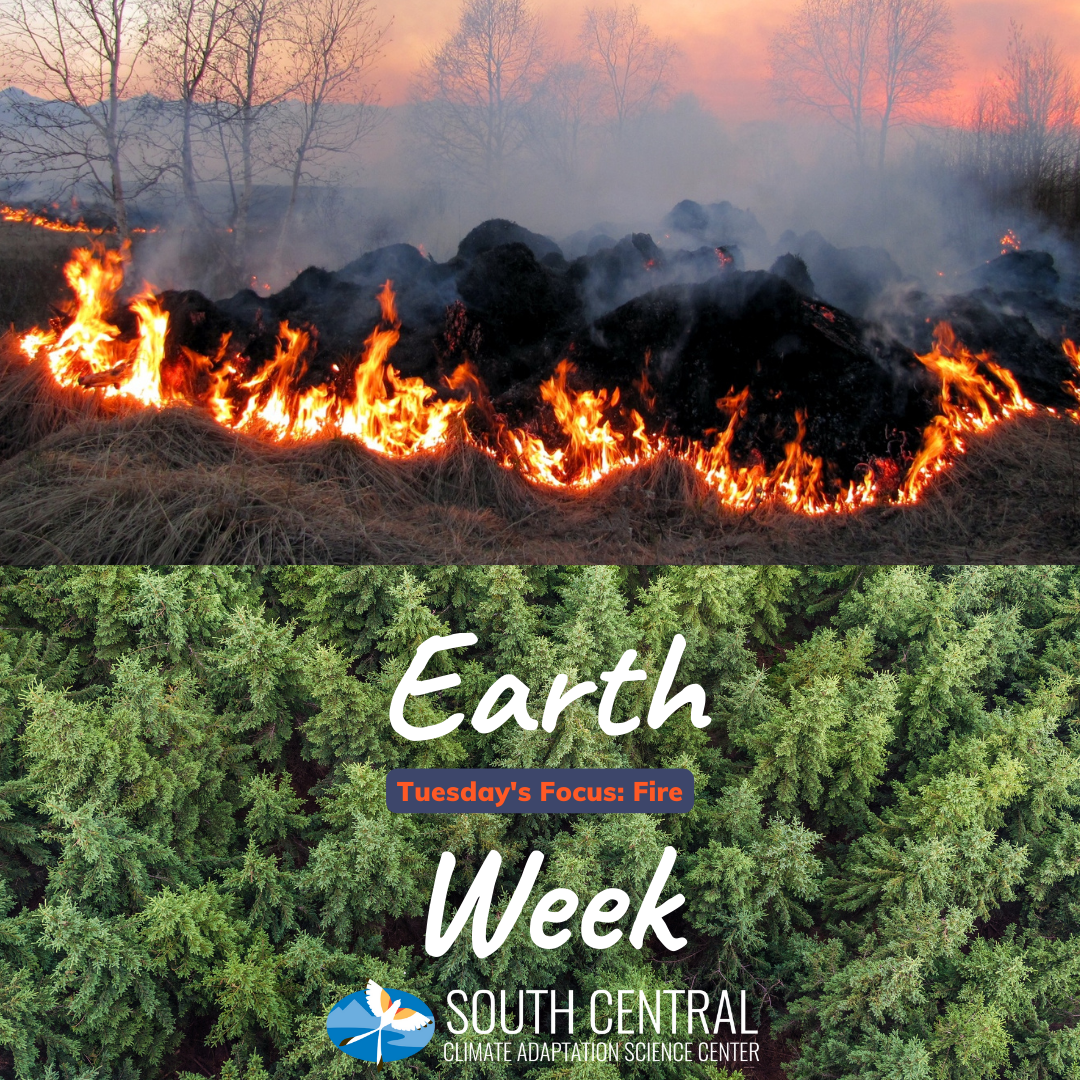
Tuesday: Fire
Future of Fire in the South Central: Towards a National Synthesis of Wildland Fire Under a Changing Climate – Omkar Joshi, Oklahoma State University (Funded Fiscal Year 2020)
There is a real risk of increased wildfires, but prescribed burns are a common solution to such risks.These practices help minimize the destruction by lessening the intensity of future wildfires. Not without real and perceived risks that concern fire management practitioners, though (e.g. bodily injuries, stress from smoke, and liability). Dr. Omkar Joshi, Oklahoma State University, is the South Central CASC PI on a Nationwide fire research project, “Future of Fire: Towards a National Synthesis of Wildland Fire Under a Changing Climate“. Dr. Omkar’s portion of the project will concentrate on the nexus of climate change, prescribed fire, risk analysis, tolerance, and communication.
https://www.sciencebase.gov/catalog/item/617996e1d34ea58c3c6fa1f0
The Effects of Wildfire on Snow Water Resources under Multiple Climate Conditions – David Moeser (2017, Completed)
Wildfires can have an impact on The Colorado and Rio Grande Rivers as temperatures rise and become more common. Snowmelt accounts for over half of the streamflow in these rivers. Snow accumulation and snowmelt patterns in the mountains directly impact water availability. Mountain forests are a critical part of the hydrologic cycle that feeds these rivers, providing water supply and storage. However, wildfire can disrupt the role of mountain forests in the hydrologic cycle. Uncertainty about the interactions between wildfire and snow-water and how these interactions may change as climate conditions shift impedes effective water resource planning in the region. This project will combine two newly developed models that will allow an accurate analysis of the effects of wildfire on snow-water resources under current and possible future climate conditions. The results will improve snow-water forecasting and, therefore, water resource planning. https://www.sciencebase.gov/catalog/item/594aa2dfe4b062508e36f465
Wednesday: Wildlife

Assessing future climate impacts on endangered and threatened groundwater dependent species in the Edwards Aquifer region using a novel hybrid artificial intelligence framework – Ali Mirchi, Oklahoma State University (Funded Fiscal Year 2021)
The Edwards Aquifer in south-central Texas provides water resources to millions of people and is home to eight federally listed threatened and endangered species that are dependent on spring flow from the aquifer for survival. Recent global climate models indicate that there will likely be increases in annual average temperatures and evapotranspiration in this semi-arid region. The research team will produce cutting-edge artificial intelligence models and climate data products to better understand how the Edwards Aquifer system responds to future climate variability, which will be a powerful tool for the Edwards Aquifer Authority to develop and execute groundwater and habitat management plans that will support healthy spring ecosystems.
https://www.sciencebase.gov/catalog/item/6000c395d34e592d8671f606
The Impact of Future Climate Variability on Shorebirds and Their Wetland Habitats in the South Central U.S. – Craig Davis
Migratory shorebirds (a diverse group that includes sandpipers and plovers) undertake long-distance migrations and have experienced sharp population declines, partly from the loss of migratory wetland stopover sites. Climate change imperils wetland health, including impacting the connections among wetlands that facilitate movements and prevent extinctions of wetland-dependent wildlife. This study will provide predictive tools that help managers and policymakers identify critical sites and regions contributing most to connectivity for shorebirds and other wildlife. https://www.sciencebase.gov/catalog/item/5f04ca4782ce21d4c3f89cbf
A roadmap for developing resilient oyster populations: using spatial and process-based modeling for restoration under current and predicted future water quality conditions – Megan La Peyre, USGS (Funded Fiscal Year 2021)
Eastern oysters are both a critical fishery species and ecosystem engineers which provide vital habitats along with filtering water which improves water quality within estuaries. Ensuring resilient oyster populations is crucial to the functioning of these estuaries, which support many other species. A recent focus on restoration of wild populations, and development of the aquaculture industry has fueled extensive planning to ensure sustainable oyster populations for future generations. However, increased temperatures, altered precipitation, and storm pattern changes are predicted to impact the northern Gulf.
The research team will produce spatial maps displaying oyster growth, reproduction, and mortality outcomes across estuaries under current and future conditions across Texas and Louisiana. Which will assist managers in identifying suitable locations for ensuring resilient and sustainable wild populations of oysters and supporting future production and aquaculture success.
https://www.sciencebase.gov/catalog/item/6000c393d34e592d8671f602
Thursday: Water
Building Tools to Assess Climate Change Impacts on Water Resources of the Canadian River Basin – Newakis Weber
During the severe drought of 2010-2015, communities within the jurisdictional territories of the Chickasaw Nation and the Choctaw Nation of Oklahoma were precariously close to running out of water. Communities that rely on direct river diversions to supply their needs could be threatened by the predicted increase in temperatures and longer, more severe droughts. The Chickasaw Nation and the Choctaw Nation of Oklahoma have previous and ongoing studies to evaluate the impacts of climate change on river flows and are currently identifying specific communities that may be at risk due to the changing climate, which will help prioritize mitigation and adaptation activities within the Red River Basin. The research team will expand upon these existing studies by developing a RiverWare model that will provide water planners and decision-makers the tools necessary to study water needs and identify vulnerable communities in the Canadian and Arkansas River Basins.
https://www.sciencebase.gov/catalog/item/5f3157e482ceae4cb3ca50ed
Precipitation Climatology of the Mississippi River Basin landscape: Examining Extremes within the Basin with an Eye Toward Climate Change – Renee McPherson (2021, ongoing)
The greater Mississippi River Basin is a critical resource for the U.S. economy via agriculture and other work in river-related jobs across the basin. Ecologically, the Mississippi River Basin supports about 100s species and over 180 National Wildlife Refuges. Yet, the region has experienced dozens of major drought events since 2017 and over 30 disaster-level floods. Climate change is projected to continue to impact the Mississippi River Basin by disrupting the amount, frequency, and timing of precipitation events. These changes have direct and indirect impacts on aquatic and riverine ecosystems. This project aims to improve our understanding of the risks and impacts of extreme precipitation events on the fish, wildlife, and agroecosystems supported by the rivers and streams of the Mississippi River Basin. https://www.sciencebase.gov/catalog/item/615dc705d34e7b019243c02c
Friday: People
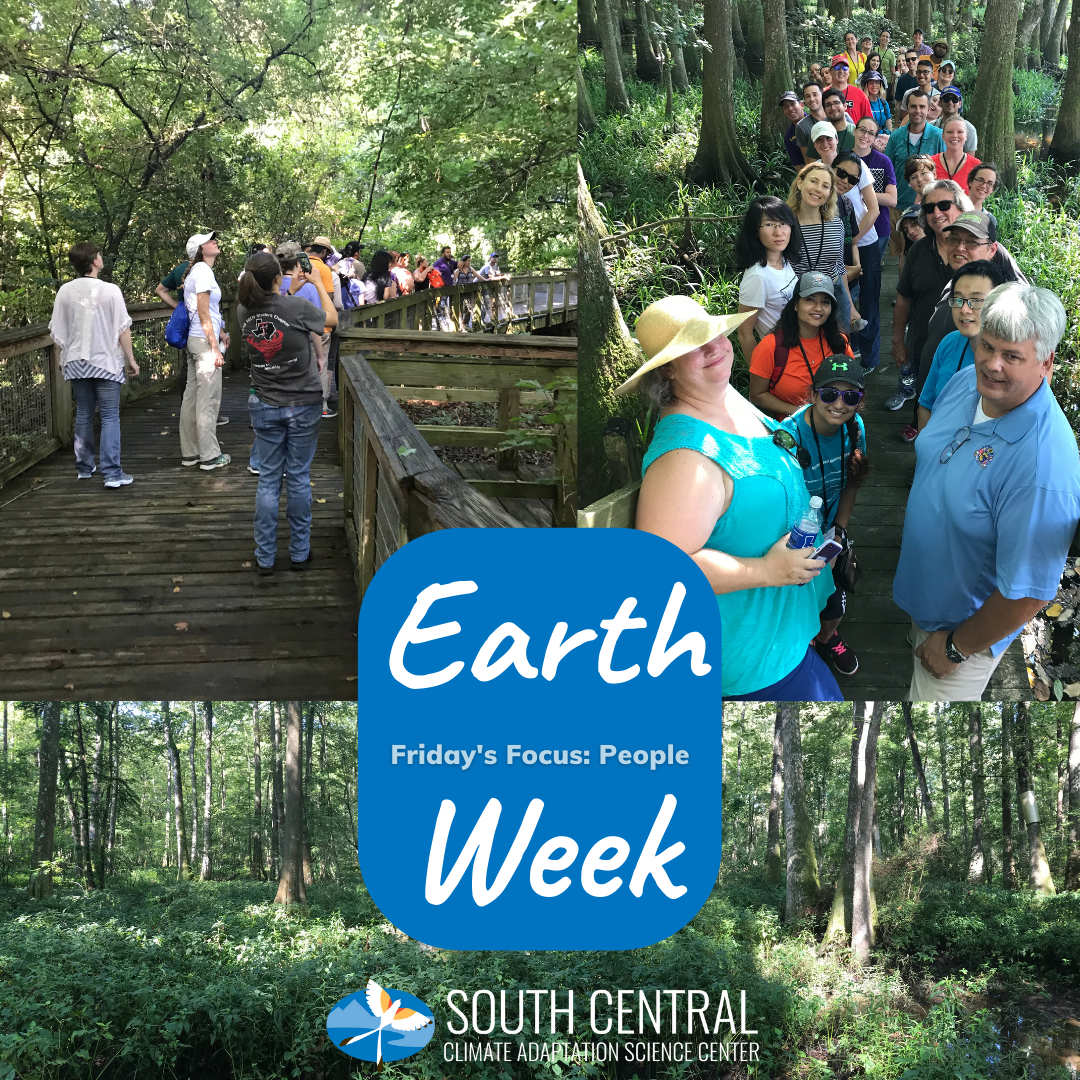
Time To Restore: Connecting People, Plants and Pollinators – Erin Posthumus (Funded Fiscal Year 2021)
Changes in climate, including earlier spring warming and warmer fall temperatures, may cause flowering to become out of sync with pollinator activity. When restoring land to support pollinators, managers are challenged to select a mix of species that support pollinators of concern throughout their periods of activity. Existing planting tools have several disadvantages, such as often not accounting for future changes in plant phenology (life cycle events) due to climate change. This project brings together a well-developed network of project cooperators to form connections among those working on pollinator restoration, provide technical support, and offer guidance to inform managers about what to plant to ensure nectar availability for pollinators. https://www.sciencebase.gov/catalog/item/60352d4ed34eb12031173ed2
Research Symposium: Culturally Significant Plants and Climate Change – April Taylor (Funded Fiscal Year 2019)
In many parts of the U.S., droughts, floods, and changes in the timing of frost events are stressing culturally significant plants and in some cases have led to decreases in their areas of suitable habitat or a reduction in their resistance to disease. A major concern for many tribal managers. Culturally significant plants are essential to many aspects of life for tribal members, including medicine, ceremonial practices, and traditional food dishes.
A research symposium was held to bring tribal resource managers and scientists from a range of disciplines in the South Central region together. In the face of changing climate conditions, this symposium will develop a network for climate-related science, resulting in new collaborations geared towards addressing tribal climate science priorities.
https://www.sciencebase.gov/catalog/item/5d49b794e4b01d82ce8de6fd
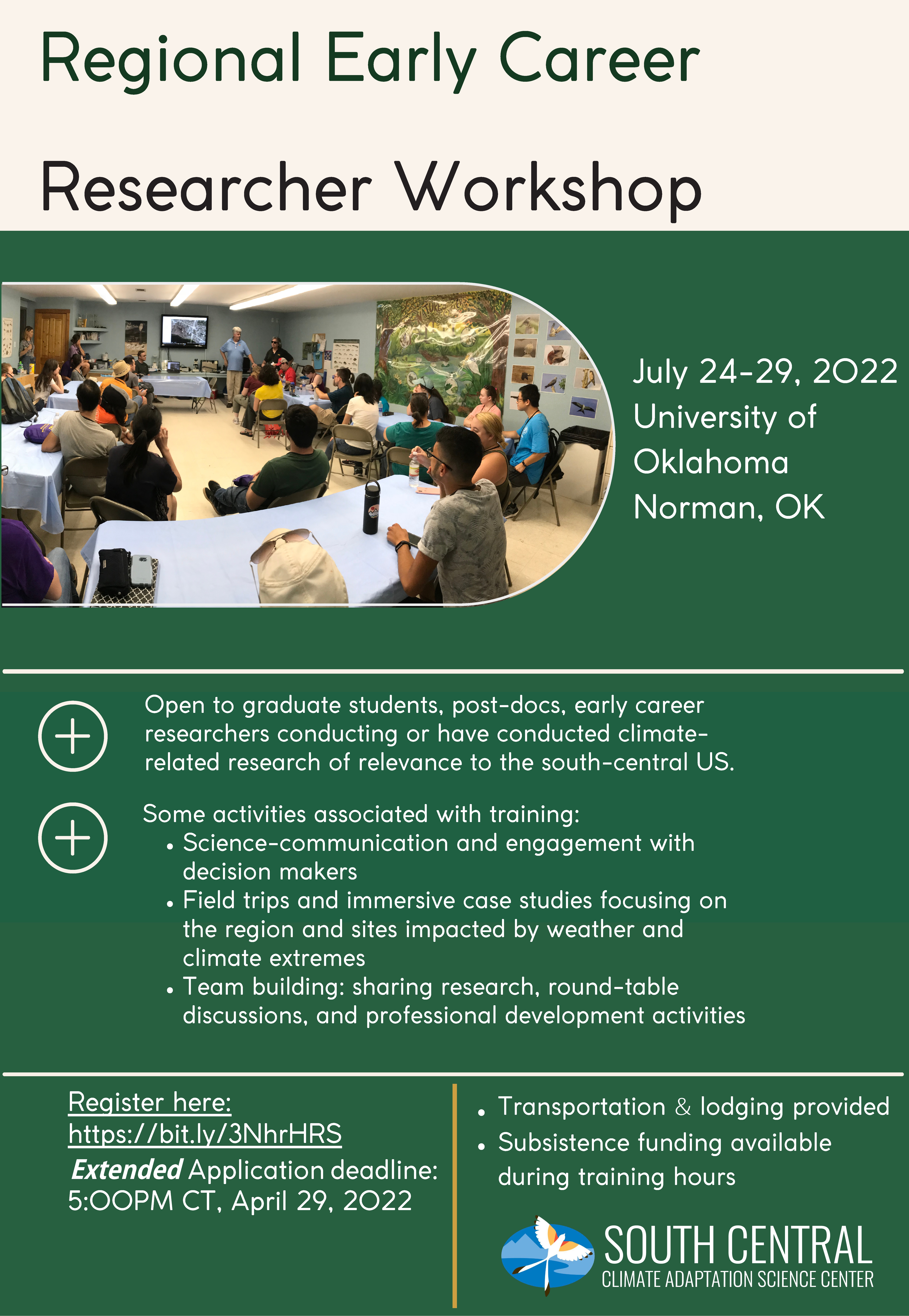
Upcoming Regional Early Career Workshop (Apply today!)
The Early Career Workshop (registration here) is led by universities of the South Central CASC and builds on the successes of three prior workshops to mentor a cohort of early-career environmental professionals in the South Central U.S. to serve as part of the next generation of USGS leaders and partners. The workshop will offer participants insight into how their research fits into the USGS’s research priority goals and its eventual applicability to management needs across the region. Providing these early-career researchers with the skills needed to conduct stakeholder-initiated research and effectively communicate their work to those who will use it will help build a diverse workforce that can produce relevant, actionable science and provide the USGS with a talent pool of future leaders.
Climate Adaptation Postdoctoral (CAP) Fellows cohort
While climate issues are often placed into broad categories, like “fires” and “drought,” their impacts vary from region to region. Local expertise within these categories is critical to create a national strategy for adapting to climatic changes, and a new postdoctoral program has been developed to deliver on this urgent need.
The USGS National and Regional Climate Adaptation Science Centers are proud to announce the creation of the Climate Adaptation Postdoctoral (CAP) Program. Each two-year fellowship is united by a central climatic issue and then distributed across the country, creating a national network of scientists united by the same topic.
The current cohort for 2021-2023 is the “Future of Fire”. The next cohort, “Future of Aquatic Flows” for 2022-2024, will be accepting applications soon. Learn more here